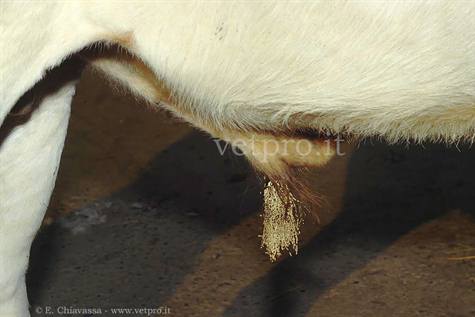
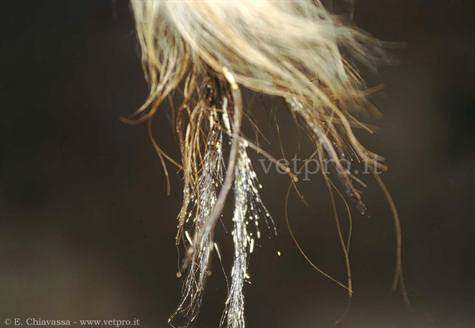
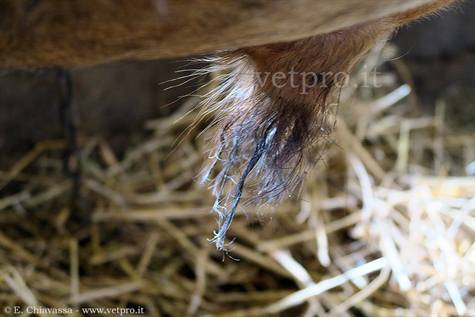
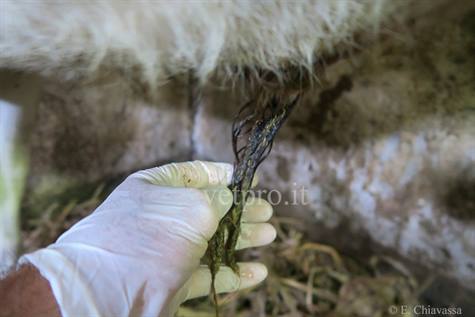
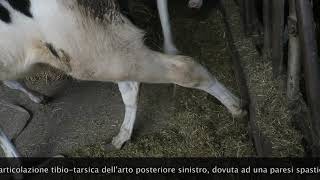
Most sacral fractures result from mounting by other animals during estrus, with crushing of the sacrum and tail between the ischial tuberosities. More rarely, they may result from dystocic calving or a fall onto the back. In the image, note the accentuation of the sacral tuberosity above the tail attachment, which is paralyzed. The anal region is soiled with feces due to the animal's inability to raise its tail during defecation. In some cases, paralysis of the anus or bladder may also develop, and in the most severe cases, paresis or paralysis of the spinal nerves of the entire hindquarters. In these cases, a bilateral knuckling of the hind fetlocks can often be observed (see "Peripheral Nervous System").
When the symptoms are not severe enough to warrant a negative prognosis and the traumatic event is recent, medical therapy can be attempted with NSAIDs or with glucocorticoids injected locally for a few days. Prompt therapeutic intervention can "freeze" the lesion at its initial stage, limiting the progressive worsening that normally occurs in the following days. Supportive therapy: vitamin B1 for a few days.
In the case of bladder paralysis, a Foley catheter can be placed in the bladder and left in situ for a few days while awaiting possible functional recovery of the organ.