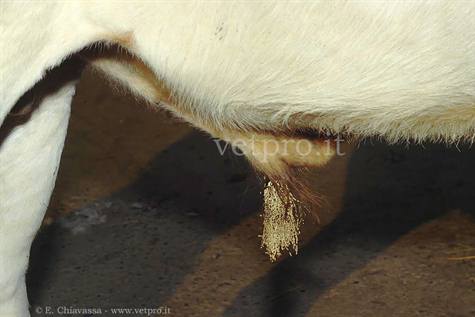
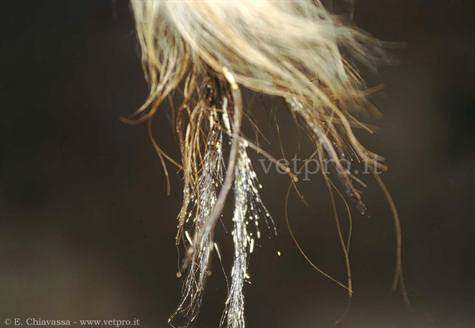
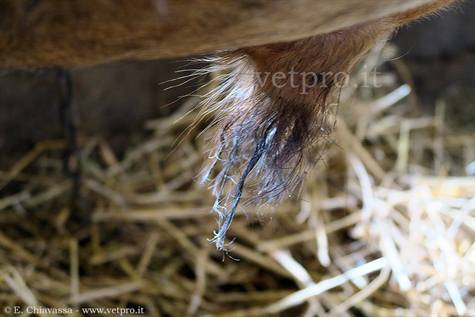
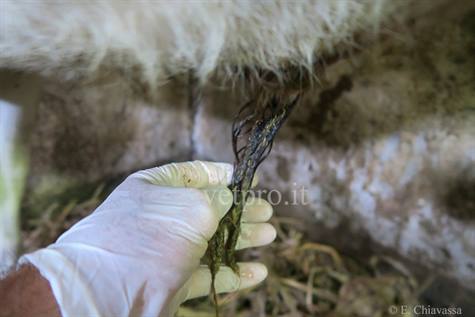
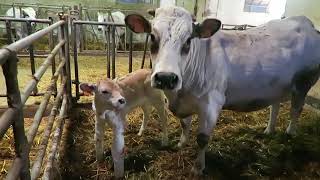
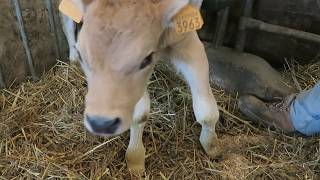
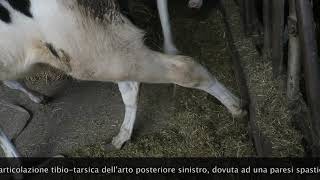
Piedmontese beef steers being finished for slaughter present with tail necrosis. This condition generally affects beef calves being fattened. It is a necrosis of ischemic origin, attributable to the presence of T-2 toxin in the ration, which is rich in concentrates or poorly preserved silage. T-2 is a group of mycotoxins produced by Fusarium, known as trichothecenes (DON, nivalenol, diacetoxyscirpenol), which are capable of prolonging partial thromboplastin time (PTT) by altering blood clotting times (Piana G., Piva G., 1975), (Martelli et al., 1993).
In dairy cows, T-2 has also been associated with hemorrhagic intestinal forms and gastroenteritis (Petrie et al., 1977) (Ih-Chang et al., 1972) (Pier et al., 1980).
Other authors have demonstrated a correlation between the presence of T-2 and a significant decrease in plasma progesterone levels, with negative effects on fertility.
Treatment: surgical removal of the tail 6-7 cm above the necrosis (or application of an elastic band), to prevent the lesion and infection from spreading upward. Antibiotic therapy with penicillins for 4-5 days. If it is not possible to replace the contaminated feed, introduce an appropriate sequestering agent into the ration.